
Moya Begins Building Full-scale Autonomous Cargo eVTOL
Moya Aero has started manufacturing the first full-scale prototype of the Moya 760, the larger of two autonomous cargo eVTOL models the Brazilian start-up is developing for logistics and agricultural missions. The first major structural component—the upper surface of the aircraft’s 7.4-meter (24-foot) rear wing—emerged from its tooling just days before the Farnborough International Airshow opened, and the company aims to fly the aircraft by the end of 2026, Andre Stein, Moya’s board director and president of Americas, told AIN.
The São José dos Campos-based company is exhibiting this week at the Brazilian Pavilion organized by the Brazilian Aerospace & Defense Cluster, where visitors can see a scale model of the aircraft. The flight-test campaign kept the real hardware at home in Brazil, according Stein, who is at the show along with co-founder and CEO Alexandre Zaramela.
Stein, who also co-founded Embraer eVTOL spinoff Eve Air Mobility and later led , joined Moya’s board this year. He also serves as president of the Americas at , a Brazilian drone-delivery operator that signed a memorandum of understanding with Moya in April. The two companies plan to pair Moya’s aircraft with Speedbird’s certified beyond-visual-line-of-sight operations experience and software, initially focusing on markets in the Americas.
His connection to Moya predates the eVTOL era. Parent company Advanced Composites Solutions, which trades as ACS Aviation, built the first subscale proof of concept for Eve’s passenger eVTOL and in 2015 flew the Sora-e, billed as the Southern Hemisphere’s first crewed all-electric airplane. Stein called Zaramela “one of my unsung heroes of aviation.�
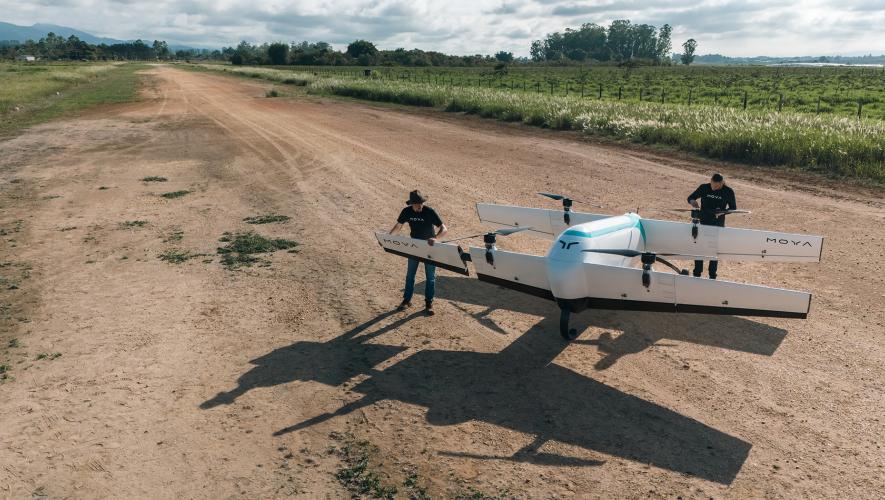
While the 760 takes shape, Moya’s smaller model is carrying the flight-test load. The Moya 256, which evolved from the technology demonstrator that first flew in November 2023, has logged some 150 flights and is preparing for its first transition from hover to wing-borne cruise, Stein said. A subscale prototype performed the program’s first full transition in August 2024, and the company completed wind-tunnel testing at Brazil’s IAE facility last year. The 256 holds an experimental flight authorization from Brazilian civil aviation regulator ANAC, which last month of the country’s drone rules with a risk-based framework, RBAC 100, replacing the weight-based classes under which Moya’s aircraft were originally categorized.
Both models share a common electric architecture and a tandem-wing configuration with two pairs of propellers, each driven by its own electric motor. Rather than tilting its wings or rotors, the aircraft rotates its fuselage between vertical and horizontal flight. The all-electric 256 can carry 30 kilograms (66 pounds) over 160 kilometers (100 miles), while the all-electric 760 can carry 190 kilograms (420 pounds) over 190 kilometers (118 miles). A hybrid-electric version of the 760, which uses a piston engine as a generator to recharge batteries in cruise, extends the range to 300 kilometers (186 miles).
Moya sees its aircraft filling a gap between small multirotor drones, which lack range and payload, and conventional airplanes, which cannot operate from unprepared sites. Stein pointed to medical and cold-chain deliveries for the more than 1,000 Brazilian municipalities located at least 150 kilometers from the nearest hospital, resupply flights to offshore oil platforms, hub-to-hub e-commerce freight, and precision crop spraying as target missions.
The company holds letters of intent covering some 120 aircraft from prospective customers that count Brazilian helicopter operator Helisul, Canadian logistics group N2 Infrastructure Technologies, and agricultural operator 7Reis Farm among them. Moya has raised $5.8 million to date, spanning a $2 million grant from Brazilian innovation agency Finep and seed backing from investors, and Stein said grant funding covers development through the end of the flight-test campaign. The company has said it is targeting type certification and service entry in 2027, and it is weighing additional fundraising to accelerate certification and its international expansion.