
Looking into the Near and Far Future of the Rotorcraft Market
While debate has waged over whether the market for new helicopters may be slowing, particularly in the face of the still nascent advanced air mobility sector, demand remains for new and upgraded products. Companies such as Bell, Leonardo, and Airbus Helicopters continue to work toward bringing these to market. Others see a growing opportunity to ramp back up on their legacy models. But all the while, several are looking into the distant future at far-reaching technologies and capabilities, such as speed, that may reshape the traditional helicopter in the future. AIN takes a look at what’s happening at many of these OEMs.
Airbus Helicopters
As H140 Advances, Airbus Helicopters Stretches toward Far-reaching Technologies
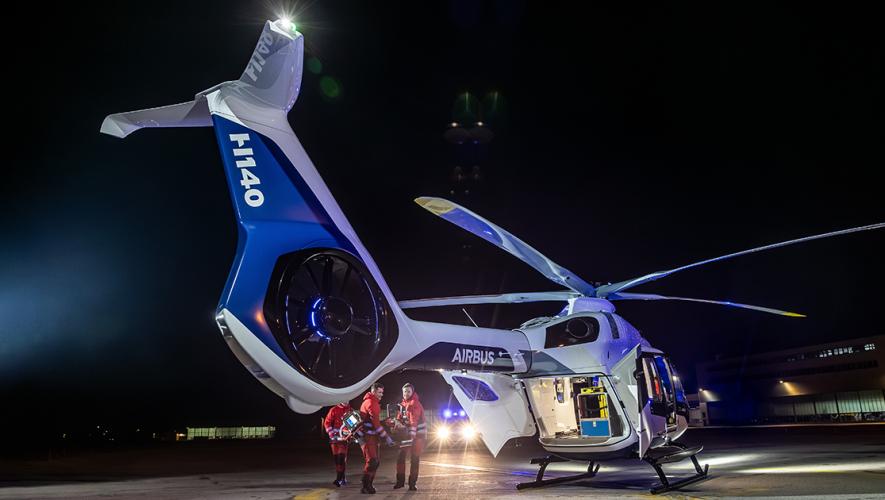
As the upcoming Airbus H140 light twin-engine helicopter is set to enter service in 2028—with the type already securing 61 firm orders since its unveiling last year during Verticon—Airbus Helicopters continues to push the technological advancements potentially applicable to its commercial offerings.
The H135-derivative features a range of innovations, including a new T-shaped tail boom with an optimized fenestron and new Safran Arrius 2E engines that will deliver around 7% more power for the same fuel burn at maximum continuous power than the current Arrius 2B2 Plus turboshaft. The H140 will share the same Helionix avionics suite as its siblings.
Currently pursuing EASA CS-27/FAA FAR 27 certification requirements, the helicopter is at the top end of the “small rotorcraft” designation with an mtow of 6,985 pounds, which is 429 pounds more than the H125.
With large windows and an optimized layout, the aircraft can seat six passengers. But it is also designed for accessibility, with large sliding cabin doors and rear loading capabilities that can accommodate various stretcher systems.
Airbus Helicopters has three prototypes in flight test and noted in December that the program was “already picking up pace for the new year.” Prototype 2 headed north for intense cold weather testing in Finland and Norway. Prototype 4, meanwhile, is expected to join the flight test activities later this year.
Advancements in aerodynamic, powertrain, fuel economy, and other operational considerations are reflective of Airbus Helicopters’ ongoing research and development activities across its flying test benches. These include the modified H130 FlightLab and the H145-derived Racer (Rapid And Cost-Effective Rotorcraft) programs, each aiming to incrementally explore and validate a variety of innovations.
Currently emerging from a maintenance layup phase, the experimental Racer is set to restart flight test activity within the first quarter of this year: a campaign that will see the platform fly with its unique Eco-Mode technology for the first time. The system was developed in collaboration with Safran Helicopter Engines and will help Airbus achieve its target of demonstrating a further 15% reduction in fuel consumption. This will build on the 25% reduction already recorded in 2025.
Upcoming enhanced coatings will further reduce drag, while autopilot-integrated software will also aim to demonstrate a noise footprint reduction of 30%, as perceived from the ground. Building on the compound-architecture aircraft’s cruise speed of more than 220 knots, demonstrations of winching and hoisting capabilities will enhance the platform’s value for future civil and military missions. Finnish, French, German, and Italian military pilots have been “really positively surprised” by their experiences at the flight controls, Racer chief engineer Brice Makinadjian told AIN.
Meanwhile, flight testing of the H145-derived PioneerLab demonstrator—including additional aerodynamic improvements to the fuselage—is set to continue until around the third quarter of this year. This campaign will seek to refine PioneerLab’s automated takeoff and landing system, which combines a network of external cameras with an automated path correction system and AI-enabled image recognition.
During a fully automated approach into Airbus Helicopters’ Donauwörth, Germany facility last year, “the helicopter was capable of recognizing [a simulated obstacle], detecting it, and then performing an avoidance maneuver before touching down,” explained project manager Dominik Strobel. Up next, the team plans to replicate the feat at an unprepared site.
Building on a preliminary design review conducted in 2025, Airbus is set to complete a critical design review for the PioneerLab mid-year. This design freeze will precede the installation of an experimental hybrid-electric propulsion system, substituting the existing two Arriel E turboshafts with a single Pratt & Whitney Canada PW210S engine and two Collins Aerospace 250-kW electric motors and controllers. Strobel is confident that it remains on schedule to achieve its first flight in 2027, despite recognizing the “many dependencies with [project] partners” working across different sites. C.B.

Bell
Bell Puts Finishing Touches in Place for 525 Certification
Bell continued to put the pieces in place for a smooth entry into service of its fly-by-wire 525 super-medium twin in the months in advance of Verticon as the Fort Worth, Texas manufacturer edged closer to certification.
In the works for well more than a decade, the 16-passenger 525 is poised to help nose up into markets such as oil and gas and search and rescue, as well as corporate/VIP applications with multiple seating configurations, including a high-density layout of up to 20 passengers.
But importantly, the 20,500-pound (mtow) 525 is the first civilian helicopter design with a fly-by-wire system. The triple-redundant system is designed to ease pilot workload but provide maximum pilot control, the company maintains. ÿÈմóÈü Powered by GE CT7-2F1 turboshafts, the 525 has a 619-nm range and can fly at 160 knots. The cockpit features Garmin’s G5000 suite with four high-definition displays and two touchscreen controllers.
By this time last year, the model had checked off more than 60 certification deliverables and many key type inspection authorization flight tests. Those flight tests had continued through late last year as the program weathered a historically long government shutdown in October and November.
Concurrently, Bell has been expanding the helicopter’s capabilities with testing in areas such as cold weather and full icing. Bell senior v-p 525 program Mike Deslatte said both areas are anticipated to be introduced after initial type certification of the aircraft.
In addition, the company has made strides in other areas, such as training. The Bell Training Academy in November received FAA interim level-C training device qualification for the 525 simulator produced by sister company TRU Simulation. This enables Bell pilots to earn flight hours on the platform—which is being certified under FAA Part 29 and thus requires a type rating—ahead of type certification.
“This milestone is a great step toward preparing our teams for future operations with the Bell 525 and future pilots for type rating,” said Deslatte. “Now, our pilots can log Bell 525 flight hours and build on their aircraft knowledge from flight test operations.”
Bell has a joint offshore operational evaluation agreement with Omni Helicopters International for the 525 that will be conducted over several months in Georgetown, Guyana. Once certified, Bell will operate the helicopter in concert with Omni in a series of missions, visiting multiple offshore installations in the region, the companies announced during the 2025 Verticon event. Other previous contracts included a purchase agreement with Equinor for 10 aircraft that will be used in North Sea offshore operations.
As for when certification may happen, Bell is no longer projecting a date for the program that launched in 2012, which has encountered multiple setbacks, including Covid and a loss of a test vehicle, but many believe it may be imminent.
Meanwhile, Bell continues to progress and advance its other models. It has been involved in a sustainable aviation fuel test program of its 505 light single in collaboration with Safran Helicopter Engines. That teaming was announced in March 2022, and by the following year, the Arrius 2R-powered 505 had become the first single-engine helicopter to fly with 100% SAF during a demonstration flight. That test program has since continued with Bell racking up more than 700 flight hours using blended SAF in a Bell 505 at its Bell Training Academy in Fort Worth, Texas.
The company added that its assessments of engine operability and aircraft performance, along with inspections, have yielded positive results to date.
Jean-François Sauer, executive v-p of programs for Safran Helicopter Engines, noted that the Arrius 2R is able to operate with up to 50% drop-in SAF and added, “Very soon, our engines will be capable of 100% drop-in SAF, paving the way for wider use of this type of fuel for increased sustainability of helicopter operations.”
In early January, the 505 was selected for the next phase of the Flight School Next competition for training U.S. Army aviators at Fort Rucker in Alabama. Contract award for the potential multi-decade program is anticipated later this year.
Bell also has been busy in multiple research programs, including last year’s down-selection for Phase 2 of the Defense Advanced Research Projects Agency’s (DARPA) Speed and Runway Independent Technologies (SPRINT) vertical takeoff and lift X-plane.
The SPRINT program will study the ability of helicopters to operate at speeds from 400 to 450 knots and to hover in an austere environment without prepared surfaces. Phase 1A and 1B involved the completion of conceptual and preliminary designs, while Phase 2 moves into detailed design and build, with flight test occurring in Phase 3.
Leading up to development, Bell had undertaken several initiatives to reduce risk in the program, including demonstrating folding rotor, integrated propulsion, and flight control technologies at Holloman Air Force Base in New Mexico. It has also conducted wind tunnel testing at the National Institute for Aviation Research (NIAR) at Wichita State University. K.L.
Enstrom
Firing Up Production Lines
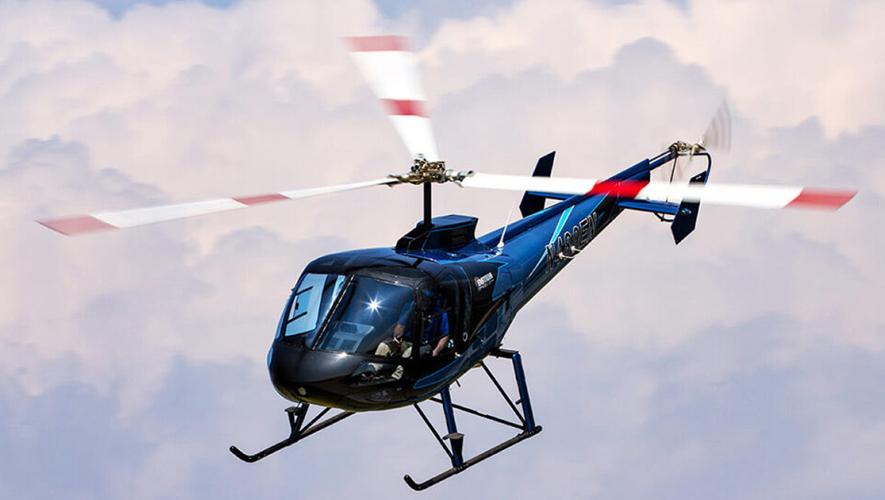
Following the FAA’s and EASA’s certification of its crash-resistant fuel system (CRFS) on the 480B turbine-engine helicopter, Michigan-based Enstrom Helicopters is now gearing up to resume deliveries of new aircraft for the first time since it was sold out of bankruptcy in 2022.
“When the bankruptcy happened, the FAA more than paused our production certificate,” explained Charles Wade, Enstrom’s senior v-p of product, sales, and customer excellence. “We had to earn it back, so there was a process we had to go through, and that took time.”
During that span, the agency had instituted a mandate that all OEMs integrate CRFS technology into their new-build rotorcraft to minimize the risk of post-crash fuel fires. Enstrom had partnered with Safran Aerosystems to develop the CRFS fuel bladders and other necessary components to achieve compliance. Safran also managed the CFRS testing program to support the recertification of both the 480B and the piston-powered 280FX, which is undergoing ground and flight testing in anticipation of FAA approval in the second quarter.
With the return of new aircraft production, Enstrom will now offer the three tiers of equipage on the 480B, first announced at last year’s Verticon. Analog instruments are included in the standard 480B, while the Signature and Elite versions will offer an all-glass Garmin cockpit, which is awaiting FAA certification. The Elite will feature custom paint schemes, upgraded cabin furnishings, Genesys three-axis autopilot, and cabin air conditioning as standard. The latter two features will be available as options for the Signature model. “Right now, the base model 480B, we can build and deliver them today,” Wade stated. “It’s really the Signature and the Elite models, because of the glass certification, that are a few months behind the standard.” FAA certification for the new avionics suite on those models is expected by mid-year. Wade noted that Enstrom currently has eight assembled 480Bs, including one standard model, while the other seven await authorization. Two more are under construction.
Once the certifications are wrapped up, Wade said he expects production to ramp up on the 480B. “We’d like to produce about 15 or 16 of them this year; [this] is kind of what we are forecasting,” he explained, adding he expects to produce 10 piston 280FXs as well as the facility spools up. “Now that we have these certifications, we’re provisioning a line,” he told AIN. “If you count the 280 and 480 models together, we should be getting into that 40 to 45 range pretty easily.”
The span in which the facility was actually idled was a short one, according to Wade. “We were very fortunate that the shutdown was only a couple of months long,” he said, adding that the OEM was able to bring back some of its key production staff. “That gave us a great foundation for managing the ramp-up, and we’ve just been building on that core competency since.”
While the company had not delivered new rotorcraft for the past several years, its production lines were kept busy producing parts to support the global fleet of more than 700 Enstroms in service. “We’ve been doing a lot with the aftermarket business,” explained Wade, who joined the company in late 2024. “Obviously, the machines and the manpower are common between production and aftermarket. By virtue of having that aftermarket business, it’s been able to keep things running down there.”
At its booth at Verticon this year, the airframer will be displaying three of its helicopters, a Signature and an Elite 480B, and a 280FX, as it looks to grow its order book. “Enstrom is really excited, and I think 2026 is going to be a fun year,” concluded Wade. “We’re turning a big corner.” C.E.
Leonardo
Two Long-held Projects Approach the Finish Line
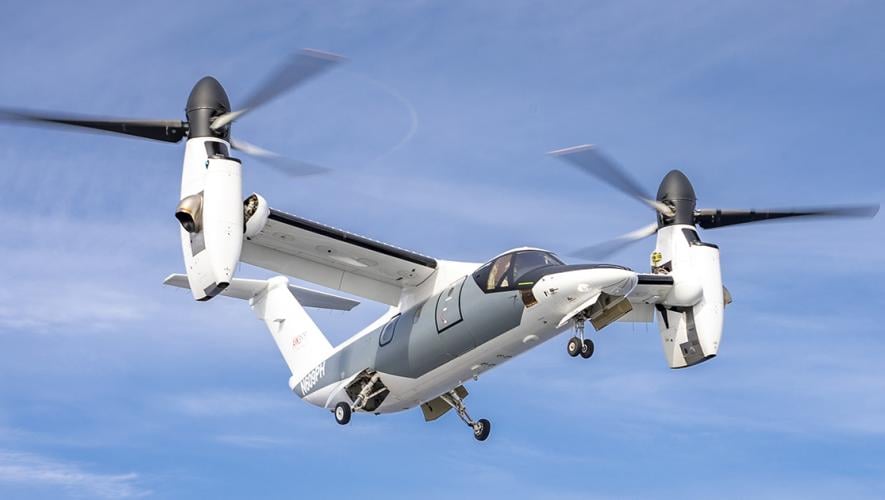
Leonardo is pushing ahead with certification plans for two new aircraft: the twin-engine AW609, set to become the first civilian tiltrotor when it enters service, and the single-engine AW09. Despite delays to both programs, both upcoming aircraft could be set to receive regulatory approval this year.
In March 2025, FAA pilots began type inspection authorization flights on the AW609 tiltrotor from the manufacturer’s Philadelphia plant, a welcome milestone in an admittedly protracted certification campaign. Since finalizing its acquisition of the program (previously the Bell-Agusta BA609) in 2011, Leonardo stated that at the time it was initially targeting FAA certification “in the first half of 2016 and deliveries following immediately afterwards.”
However, the program has been dogged by a decade of serial delays and certification expectation extensions, in part attributed to the technical complexity of the AW609’s triple-redundant fly-by-wire flight controls. The tiltrotor configuration also presents its own certification challenges, with Leonardo explaining that the platform must meet “the highest FAA requirements for both fixed-wing airplanes and helicopters, including single-engine operation and autorotation.”
In March 2025, a Leonardo representative stated that the company “won’t speculate on the AW609 certification date as [it continues] to work toward the end of development.” However, the Bristow Group has already been named as the type’s U.S. launch operator, ordering two units in 2016.
Leonardo states that the AW609’s cruising speed of almost twice that of a conventional helicopter at 270 ktas makes it ideally suited to missions including parapublic, medical, search and rescue, offshore energy, and executive transport. Sporting two Pratt & Whitney Canada PT6C-67A engines, the AW609 has a maximum range of 1,000 nm and a ceiling of 25,000 feet.
In the single-engine space, Leonardo made the first flight of its production-representative AW09 in August. This was conducted from its main production site in Italy. At the time, Leonardo stated that “the program’s industrialization phase moves forward, while ground and flight certification tests proceed at a high pace.”
Although the OEM had hoped for EASA certification in 2025, this was hindered by a five-month pause in flight test activity from late 2024, attributed to gearbox issues.
In August, however, Leonardo reported that the program had taken a significant step forward with the first serial-production copy, S6, taking to the skies at the company’s final assembly line facility in Varese, Italy, where the aircraft was built. Leonardo has since shared that the campaign has been “demonstrating strong progress toward certification” with flight testing on the prototypes PS4 and PS5 completed.
“All the Leonardo and Kopter teams are fully engaged as we advance through the AW09 certification campaign,” said Marco Viola, CEO of Leonardo’s Kopter Group. “We are performing extensive test activities, while S6 now plays a central role in validating the maturity of the design.”
Nevertheless, the Safran Arriel 2K-powered helicopter has already garnered around 130 preliminary sales contracts globally.
Leonardo describes the eight-passenger AW09 as the “first all-new design in its weight class for more than 30 years,” adding that its flexible cabin layout helps equip it to perform multiple missions across different applications. The OEM also states it is the only single-engine helicopter to feature a “native connected aircraft" concept that enables seamless and automatic download of data at the end of each flight, together with advanced flight tracking capability.” C.B.
Robinson Helicopter
R88 Progress Accelerating as Testing Continues
As Robinson Helicopter climbs out of a supply-chain crisis and engine delivery delays that slowed deliveries of its R66 turbine helicopter, the Torrance, California company has made significant progress in development of a new platform, the R88. Meanwhile, deliveries of the iconic R22 two-seat trainer are growing while Robinson is pushing forward on its effort to help owners and operators fly more safely. Rolls-Royce is recovering from delays in manufacturing a key engine component, the centrifugal compressor impeller, and engine deliveries are accelerating.
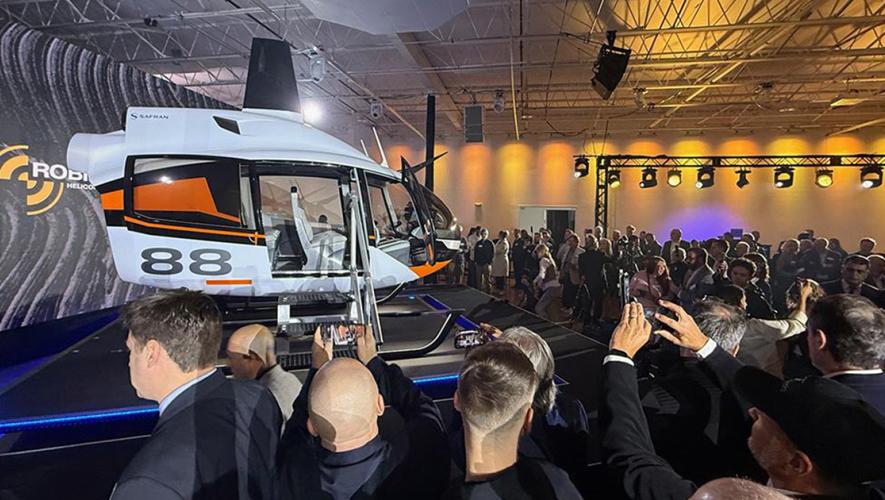
Unveiled during last year’s Verticon, the R88 is Robinson’s largest helicopter, capable of carrying 10 occupants, with a 275-cu-ft cabin for up to eight passengers or 1,800 pounds of payload with full fuel. Power is provided by a Safran Helicopter Engines Arriel 2W capable of producing 1,000 shp. Certification and entry into service are expected to take place later this decade, and the R88 will sell for about $3.3 million.
A key element of the R88 design is the input drive shaft, which connects the engine to the main transmission. “Input drive shafts are really tricky. That’s one of the hardest challenges on any helicopter, the ability to take relative motion between gear boxes and engines and throughout all sorts of maneuvers and transients,” Robinson president and CEO David Smith told AIN.
Rather than adopt a conventional design, such as the Kamatics KAflex that Smith’s former employer, Bell, uses in many of its helicopters, he wanted something less expensive that doesn’t require the complex overhaul process associated with a proprietary product. “It’s a fine product, but we want a different solution,” he said.
“The technology that we’re using for our input drive shaft is such an interesting improvement over the products that our competitors have used. Because we in the industry go to these single-source operators that control the aftermarket and specialty intellectual property, we avoided all of that with this design, and it works really well. We’re hundreds of hours into testing, full speed, full power, and it’s working like a champ. I think we’ve got something good that’s going to cut the cost probably in half, maybe a third, for the competing product. This is going to be a design that operates well and doesn't require an obscene overhaul cost.”
Also helping manage costs is further vertical integration, down to making its own fasteners for certain hard-to-source applications, more use of robotics for repetitive work like sanding rotor blades, and putting new five-axis milling machines to work making hydraulic components that Robinson used to purchase from vendors. “That accelerates our iterations through the design cycle and gets the parts in test sooner, and allows us to then make the next iteration on the design,” Smith said.
A new, larger water-jet machine will be used for cutting R88 sheetmetal parts, including rotor blade skins for blades that are three feet longer than the R66’s. Repetitive tasks such as machining, welding, and sanding are being augmented by dedicated robotic centers, Smith explained, “all areas where we have high injury risk and repetitive motion injury risk.” The idea isn’t to replace workers but deploy them to more important work, like the final sanding of rotor blade bond lines that can’t be done precisely enough by machines. “There’s about 20% of the blade they can’t do with robotics,” he said. “The resolution of their movement isn’t sufficient to do some of the most critical bond-line sanding.”
An in-house team developed a robotic process for manufacturing blade weights that eliminated a significant amount of labor. “We tried working with third-party integrators for this stuff,” Smith said, “and they failed us. The guys have been really incredible because they learned to code the robot. This is stuff that I would have loved to have done in my previous life, but work restrictions under the labor contracts at my previous employer made it difficult. Here, we have the flexibility to do end-to-end innovation. There’s still a lot of work for the same technician…so we’re hiring; we need probably another 75 to 100 people to do the things that are ahead of us.”
Robinson has also invested in inspection technology to speed quality control processes. R88 cabin assembly is well underway and in testing, along with many other components such as the landing gear and aircraft systems. “We have several reviews during the week with each system, [to] try to notice all the bottlenecks early,” he said. “We can fix, or we can change the path that we’re going through so we can deliver on time. I want the customer to know that we are doing our best to deliver them a product that they’re going to be happy with, and we’re not going to cut any corners.” M.T.
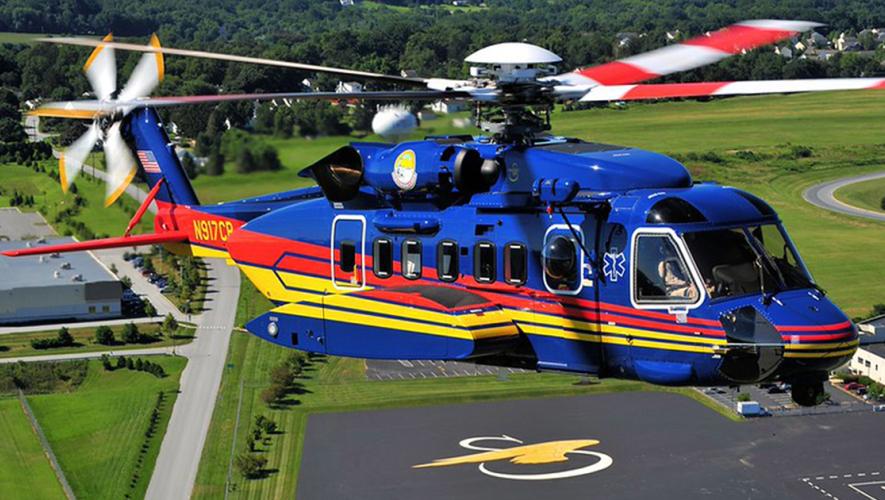
Sikorsky
Sikorsky Finding Renewed S-92 Market Life with A+ as It Weighs Next Options
As it anticipates the certification of its S-92A+, the latest upgrade to its venerable large-cabin helicopter, Sikorsky is seeing renewed interest in the platform. The improved version will center around the OEM’s Phase IV gearbox, which it has been for more than a decade at an investment cost of more than $100 million.
A key feature of the new gearbox is an independent, auxiliary oil lubrication system with its own three-gallon reservoir that will kick in if the oil pressure in the primary system fails. Another part of the A+ package benefits is a 1,200-pound increase in the helicopter’s capability, which will translate to extra fuel capacity, extended range, and/or extra load weight. In addition, Sikorsky’s engineers anticipate a higher TBO than the previous Phase III gearbox.
While the Connecticut-based OEM has had low production rates for the S-92 for the past several years, that is about to change. “We’re seeing a lot more interest,” said Leon Silva, Sikorsky’s v-p of global commercial and military systems, adding that the rotorcraft is viewed favorably for both VIP and utility transport. “Heads of state seem to be kind of the ones leaning first, but we have active proposal activity for offshore oil, and that’s the first time in a number of years that that has actually been a serious conversation.”
As well, the airframer sees new opportunities for the S-92 in the search and rescue (SAR) role. “We’ve seen this coming a little bit, customers around the world that were using Mi-17 and Mi-8s, Russian helicopters that are now very difficult to maintain, are now looking at alternatives,” Silva told AIN. “We have been doing work to improve the ability of the S-92 to carry external loads, which is important for those types of utility missions, and we expect later this year to have some further progress on that.”
Sikorsky anticipates deliveries of the first S-92A+ in 2028 and is establishing a new production line at a location that will be disclosed at this year’s Verticon show in Atlanta. Silva said the new assembly line will allow it to ramp up production to meet demand. “We’re going to go up to six [a year], we already have work for that, and we’re scaling up to be able to do 12 a year.”
“It gives us stability,” Silva continued, “the ability to be more price competitive because obviously building a larger number gives us a better opportunity to work with the supply chain and get better pricing opportunities.” He added that supply chain improvements have also improved the availability of the existing S-92 fleet, which now totals around 270 in active use of the 310 it has delivered. Of those aircraft, Silva said approximately 75% are in use in offshore oil and gas transport, while VIP, SAR, and utility make up the remaining quarter.
At last year’s Verticon, Sikorsky showed off a new, later-stage life use for the platform developed by S-92 lessor Milestone Aviation in cooperation with operator VIH Helicopters. It marked the first aerial firefighting configuration of the helicopter available to the commercial market, and that has been progressing, with the conversion of more airframes, including the first production S-92, delivered in 2004.
As for the S-92’s smaller sister, the S-76 ceased production in 2022, and the manufacturer has been weighing plans for a possible successor. “We’ve made more progress,” said Silva. “We’re pursuing about four possible paths, and I think 2026 is going to be the year that we define one of those that moves forward.” While he declined to provide further details, Silva did mention that he has now assigned a dedicated program manager to the project. The OEM has also established an industry advisory board to provide feedback on what any midsize rotorcraft should include in terms of capabilities.
One of the questions going forward with any new aircraft program is the type of propulsion system it will employ. The company has been working on new designs using hybrid electric propulsion systems that it is developing in-house. Sikorsky has successfully a blown-wing tailsitter uncrewed air system, which it views as both a possible commercial product as well as a stepping stone to a larger hybrid-electric demonstrator (HEX) UAS, and eventually on to a commercial product.
“We’ve made a lot of progress on the power systems test bed,” said Igor Cherepinsky, director of Sikorsky Innovations, the company’s rapid prototyping group. Cherepinsky added that the unit is undergoing engine-on testing: “It’s been assembled, we’re planning to fly it this year.” In addition to the powertrain, the HEX is also expected to be an incubator for other technologies, such as additive manufacturing, which will eventually find their way into the airframer’s main product lines as a solution to expensive, long-lead-time parts such as forgings and castings.
As for what architecture those future products will incorporate, Cherepinsky said it is still too early to speculate. “We definitely see more than one product coming out of it. “It’s not going to be whether we’re going to make a single main rotor, or whether we’re going to make a tilt-wing; it’s really which one is coming first?” C.E.