

Exclusive: Inside 贰厂础鈥檚 Falcon 900 mission to witness the final descent of the Cluster satellites
When fall back to Earth, most disappear unnoticed, burning up high above the oceans in a violent but largely unseen process.
For the however, the final descent of its remaining Cluster spacecraft will be anything but routine.
Earlier this year, ESA executed a carefully timed set of manoeuvres, subtly adjusting the orbits of its final two Cluster satellites, Samba and Tango, so their controlled re-entries can be observed from a Falcon 900 research aircraft. The spacecraft will descend roughly 24 hours apart, on 31 August and 1 September 2026, over a remote stretch of the South Pacific Ocean.
Moving satellites in space to meet a plane in the sky may sound dramatic, but re-entry specialists believe the scientific return justifies the effort.
鈥淢oving two satellites to meet a plane sounds extreme, but the unique reentry data we鈥檒l collect is worth orchestrating the challenging encounter over a remote stretch of ocean,鈥� says Beatriz Jilete, space debris systems engineer at ESA.
Why ESA is observing satellite re-entry and spacecraft break-up
When satellites re-enter Earth鈥檚 atmosphere, they are travelling at almost seven miles per second.
Friction with increasingly dense air generates enormous heat. Structures weaken, materials melt and fragment, and most components disintegrate before reaching the ground.
But 鈥渕ost鈥� is not good enough for engineers designing future spacecraft.
Scientific data about exactly how satellites break apart during atmospheric re-entry remains surprisingly limited. Models exist. Wind tunnel simulations exist. Arc-jet facilities can reproduce extreme temperatures. But real-world data collected during an actual descent is rare.

鈥淲ith better data on exactly when and how they heat up, break up, and which materials survive, engineers can design satellites that burn up completely 鈥� so-called design-for-demise satellites,鈥� Stijn Lemmens, Senior Space Debris Mitigation Analyst at ESA, tells AGN. 鈥淏ut such reentry data is very hard to collect.鈥�
Reentries occur at altitudes of around 50 miles, or more than 260,000 feet, far too high for balloons and far too low for most satellites to observe effectively. The events are brief, violent and usually unpredictable in location. Ground observers rarely know exactly where to position themselves.
Cluster changes that equation.
The ESA Cluster mission and its controlled satellite re-entry
Launched in 2000, the four Cluster satellites were designed for a two-year mission to study Earth鈥檚 magnetosphere, the invisible magnetic shield that protects the planet from solar radiation.
Instead, the four identical spacecraft 鈥� Rumba, Salsa, Samba and Tango 鈥� continued operating for almost 24 years in highly elliptical orbits stretching more than 80,000 miles from Earth.
Their scientific output transformed understanding of space weather and geomagnetic storms. But their unusual orbit also made the end of their life technically demanding.
Unlike satellites in that slowly drift down as atmospheric drag pulls them lower, Cluster鈥檚 path was strongly influenced by the Moon and Sun. That meant predicting its final re-entry corridor was more complex and uncertain.
As their mission ended, ESA chose not to leave their fate to natural orbital decay. Instead, engineers performed targeted re-entries over the South Pacific Ocean Uninhabited Area, a remote region chosen to minimise any residual risk.
The first two spacecraft, Salsa and Rumba, re-entered in 2024 and 2025. The 2024 descent was observed from an aircraft, a business jet equipped with 26 synchronised cameras across six instrument stations.
鈥淭he reentry was captured by various onboard instruments, even though the predictions were slightly off,鈥� Lemmens says. 鈥淚t was a tense time until the sighting could be confirmed definitively.鈥�
The infrared cameras detected the spacecraft for approximately 23 seconds. Those seconds mattered.
Engineers observed that atmospheric density differed from models by up to 20% along the trajectory. Structural break-up appeared to begin slightly earlier than predicted.
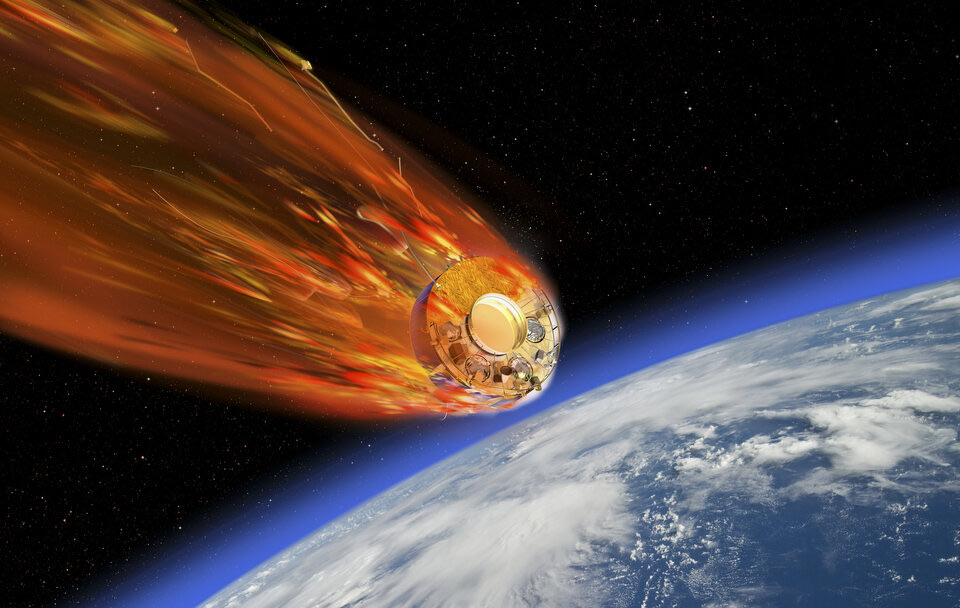
Unexpectedly, the spacecraft continued transmitting telemetry after descending through around 100 kilometres (about 328,000 feet) at extreme speed.
鈥淲e learned that spacecraft can still send data after passing through the atmosphere around 100 kilometres in altitude at over 10 kilometres per second, which was a pleasant surprise,鈥� Lemmens notes.
Each of those details refines modelling assumptions. But one observation is not enough. The remaining two spacecraft offer a rare scientific opportunity.
鈥淭he four Cluster satellites are identical,鈥� Jilete says. 鈥淏y watching them reenter the atmosphere in a predictable location with slightly different trajectories and in different weather conditions, we get a unique opportunity to conduct a valuable reentry experiment.鈥�
Repositioning Cluster satellites for a controlled re-entry over the South Pacific
The biggest logistical challenge was the timing.
The aircraft must depart from land, fly to the predicted re-entry corridor, observe the event, return to refuel and allow the crew to rest, and then repeat the process for the second spacecraft.
To make that feasible, 贰厂础鈥檚 flight dynamics team recalculated the final descent paths of Samba and Tango.
On 19 and 20 January this year, small propulsion burns nudged their orbits slightly, moving one re-entry further east and the other slightly west.
The aim was not dramatic repositioning, but a fine adjustment to ensure both events remained reachable from the same airport staging point.
After the space debris team confirmed there would be no collision risks, commands were uploaded and the satellites executed the manoeuvres as planned.
A Falcon 900 tracks 贰厂础鈥檚 Cluster satellites during reentry
The Falcon 900 cannot chase the spacecraft. The speed difference makes that impossible. Instead, the aircraft is positioned carefully beneath the predicted descent path.
A spacecraft entering Earth鈥檚 atmosphere travels at nearly 7 miles per second, while the Falcon 900 cruises at about 500 mph.
Air traffic control restrictions and safety exclusion zones further limit where it can fly.
As the spacecraft enters the atmosphere, it initially appears to approach the aircraft. Moments later, it streaks across the sky in a rapid fly-by. During this brief window, operators manually track the glowing object using high-speed optical and infrared cameras.

In previous missions, including the Hayabusa capsule re-entries in 2010 and 2020 and OSIRIS-REx return in 2023, similar airborne techniques were used successfully.
To maximise viewing time, the Falcon executes a coordinated turn during the observation. The position of that turn determines which segment of the descent is captured. Too far along the path, and early heating is missed. Too far behind, and later fragmentation disappears from view.
Operators rehearse these movements in advance. One team member calls out changing angles in real time while camera operators adjust their instruments according to precise attitude readings.
It is a short, intense, highly rehearsed moment.
The Cluster satellites transmit data during re-entry
There is another twist. The remaining Cluster spacecraft may continue transmitting data deeper into the atmosphere than their predecessors.
鈥淭he first two to reenter went into safe mode when passing through their last perigee before the reentry, because their solar panels overheated,鈥� says Bruno Sousa, Cluster operations manager at ESA.
鈥淭he panels of Samba and Tango have not degraded as much. If they remain active throughout their last perigee pass, maybe we can collect valuable data on the satellites鈥� temperatures as they dip as deep as 110 kilometres. (68 miles)鈥�
If successful, ESA could combine internal temperature readings with external optical observations, linking what engineers see from the plane with what the spacecraft experiences from within.
How Cluster鈥檚 re-entry supports 贰厂础鈥檚 Draco mission
Cluster鈥檚 final descent also serves a larger purpose.
ESA is preparing to launch Draco in 2027, a dedicated re-entry mission designed to observe its own destruction from the inside. Draco will carry more than 200 sensors, four cameras and a hardened capsule to preserve recorded data after break-up.
鈥淲ith three practice runs under their belt, the team will be able to link the observations made from the plane to what鈥檚 happening within Draco at exactly that time,鈥� says Lemmens.
The ultimate goal is confidence.
鈥淲ith the data from the Cluster and Draco reentries, we will improve reentry models,鈥� Lemmens adds. 鈥淭his helps to better predict where objects will fall and how they affect the atmosphere, and we can build better satellites to further reduce the chance of any pieces reaching the ground and posing risks to people or infrastructure.鈥�
Designing satellites to burn up safely during re-entry
In an era of rising orbital congestion, responsible satellite disposal is no longer optional. Targeted re-entries from unusual, highly elliptical orbits were once considered impractical. Cluster demonstrates that even older missions can be retired with precision.
The final moments of Samba and Tango will last less than half a minute. But those seconds may reshape how future spacecraft are designed to die.
And for the team aboard the Falcon 900, somewhere over the South Pacific in August-September, that brief streak of light will not be the end of a mission, but the beginning of better data.