
Airbus deploys tiny cabin robot to speed up A321XLR seat installation
has developed a small cabin robot that could make aircraft seat installation faster, more precise, and easier on workers’ knees and backs.
The robot, called CabinMarker, weighs just four kilograms but can complete aircraft seat positioning in 30 minutes, compared with about 150 minutes for a human. That represents an 80% reduction in task time, according to Airbus.
It is the first robot to be fully industrialised in-house by the manufacturer, developed by Airbus Robotics, founded in 2023. The CabinMarker began as a prototype at Airbus ProtoSpace in 2018, before being refined for production use. The little robot received official industrial certification in December 2025.
A small robot tackles a big production challenge
Airbus is trying to while also preparing its industrial system for future aircraft production. The company says robots are not just about replacing manual tasks, but about giving workers better tools for repetitive, uncomfortable, or time-consuming jobs.
“Robotics at Airbus has moved beyond the large stationary arms used for heavy lifting. Today, automated technologies are being introduced to the company’s industrial system,� Airbus states.
The planemaker has also introduced that help workers avoid musculoskeletal strain, as well as a FlexTrack drilling robot used on A320 Family fuselage pre-assembly lines at Airbus.
The goal of Airbus’ robotics programme is “to identify the most repetitive, physically demanding tasks and hand them over to machines.� This shift allows operators on the shop floor “to focus on more complex, high-value tasks that require human ingenuity and craftsmanship.�
Seat positioning is one of those cabin installation jobs that sounds simple but is physically demanding. Workers spend hours bending, kneeling, or crawling along the cabin floor to mark the correct seat track positions.
CabinMarker automates the marking work with high accuracy. Airbus says this improves quality and precision, reduces rework, spares workers’ backs and knees, and frees them to focus on more complex production tasks.
First stop: The A321XLR line in Toulouse
The first two CabinMarker units will arrive at the Jean-Luc Lagardère A321 final assembly line in Toulouse, France, in late 2026. Airbus says it will assist with seat fitting on the A321XLR.
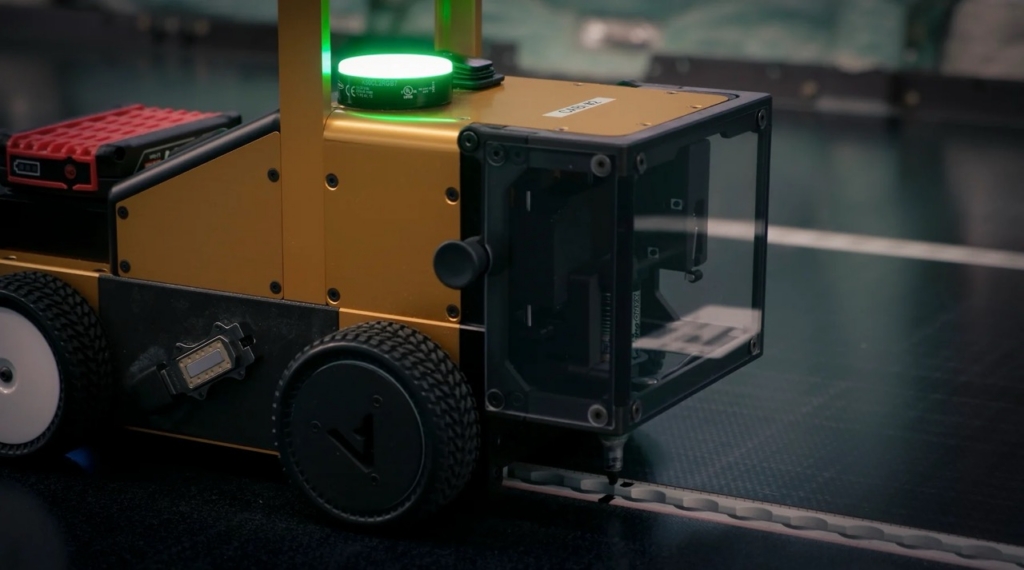
Airbus also plans to roll out the robot to other aircraft assembly facilities. The company says the average deployment could be around two machines per line, since seat fitting is not a constant activity.
Testing has already taken place on the A330 final assembly line in Toulouse. However, Airbus notes that the robot was originally designed for single-aisle aircraft, so some changes will be required before it can work on widebody aeroplanes.
More than a seat-marking robot
The new Airbus robot is part of a broader move toward more flexible, human-assisted automation on the aircraft production floor.
Airbus is already looking at future uses for the new robotic platform. By replacing the marking pen with a camera, CabinMarker could be useful in automated corrosion detection. With a vacuum and taping system, it could also help clean and tape aircraft floor rails.
CabinMarker will make its public debut as a mobile demonstrator at the ILA Air Show in Berlin in June 2026.
It could help Airbus build aircraft cabins faster and with fewer installation errors — a tiny robot doing one very specific job could make a big difference in speeding up aircraft deliveries.